
Exercise 22. Let us exercise our target grammatical time with symbolic arrow cues. We form the answers in our minds solely: this is where thinking habits take shape.
Example: generally {ON} the map for the PAST,
{ON} a PAST time extent
Answer:

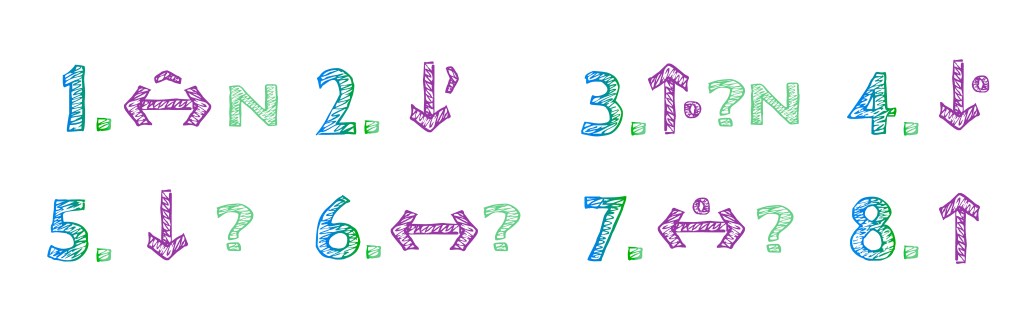
1. IN a spot within a FUTURE time extent;
2. TO a time within a PAST time extent;
3. ON the PRESENT time extent;
4. TO a time within a FUTURE time extent;
5. TO a time within a PRESENT time extent;
6. ON a FUTURE time extent;
7. IN a spot within a PAST time extent;
8. IN a spot within a PRESENT time extent.
Exercise 23. Let us gather from elements, as in ■PRACTICE 4.2, and remain focused on our symbolic cues.
Example: {TO}, 3RD, the PRESENT
Answer:

1. {IN}, ING, the PAST
2. {TO}, 3RD, the PAST
3. {ON}, the FUTURE
4. {IN}, ING, the PRESENT
5. {ON}, the PAST
6. {TO}, 3RD, the FUTURE
7. {ON}, the PRESENT
8. {IN}, ING, the FUTURE
Exercise 24. Let us try our language natures another way round. We begin with our arrow cue, and think about language elements. Let us remember about ■GRAMMAR VISUALS.

Example;
Answer: on a PRESENT extent.

Exercise 25. We may think about Bob and Jemma, to use the task from the previous exercise; our head verb can be to learn.
Example;
Answer: Bob and Jemma learn.
Please mind, we are not practicing behaviorist reflexes. We are about flexible habits. In this exercise, we prioritize the Time and Aspect.
We do not have to begin with choosing if we say Jemma learns, Bob learns, or Bob and Jemma learn. We may first imagine all grammatical person and verb forms, as in the ■Big chart, and the particular form we decide to make becomes our Expression of the Aspect.
Exercise 26. The previous exercise had all Expression in the Affirmative. Let us expand. We mark negative questions with the question mark and letter N.

Example 1
Answer: Will Bob and Jemma not have earned their credits?
Example 2
Answer: Bob and Jemma will have earned their credits.

ADVERTISEMENT
Spring Flowing Colors


Exercise 27. Let us try language logic for the Interrogative and Negative, within a PAST time extent. We can stay with the verb to learn, as well as choose to visit ■APPENDIX 2 or ■APPENDIX 3, and try other verbs.
Example:

Answer: Was Jemma learning?
We are staying in the PAST field of time, thinking about all grammatical persons. The website has ■free visual materials.




We may turn to the PRESENT time extent, after we have practiced the PAST.

Answer: Is Jemma learning?
Exercise 28. Another way round, let us begin with syntax, the Interrogative or Negative, to use the cues and variables.
If the same head verb, to learn, brings monotony, ■APPENDIX 2 or ■APPENDIX 3 can give us plenty of other verbs.
Example: Had Bob learned?
Answer:

Everyday English has abbreviated forms as doesn’t, hadn’t, and won’t. Let us think about the full forms too, exercising as in the ■MIND PRACTICE.
1. Jemma doesn’t worry.
2. Bob and Jemma hadn’t worried.
3. Is Jemma smiling?
4. Hasn’t Bob learned?
5. Bob didn’t worry.
6. Will Bob and Jemma have earned their credits?
7. Will Bob and Jemma smile?
8. Was Bob learning?
9. Bob won’t have failed.
10. Will Jemma be smiling?
Feel welcome to some more practice.
■5.3. REAL SYNTAX AND MORE WORDS
■This text is also available in Polish.

5.3. Practice: real syntax and more words
We can tell abbreviated “is” from “has” only by their contexts, as both get shortened to ’s. Abbreviated verb forms are much in use in American English. We learn telling them, continuing the practice with symbolic cues, mapping variables, and target grammatical time, plus a few irregular verbs. ■More

ADVERTISEMENT
Book format in preparation.
In the first part of the language journey, feel welcome to consider a picture for
■ the grammatical Past, Present, and Future;
■ the Simple, Progressive, and Perfect;
■ infinitive, auxiliary, and head verb forms;
■ the Affirmative, Interrogative, Negative, and Negative Interrogative;
■ irregular verbs and vowel patterns: high and low, back and front.
Third edition, 2025.


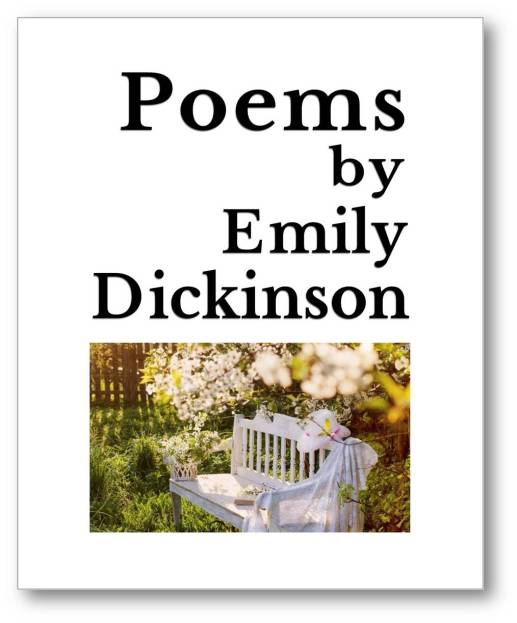
The world may never have seen her original handwriting, if her skill was taken for supernatural. Feel welcome to Poems by Emily Dickinson prepared for print by Teresa Pelka: thematic stanzas, notes on the Greek and Latin inspiration, the correlative with Webster 1828, and the Aristotelian motif, Things perpetual — these are not in time, but in eternity.
■Free access, Internet Archive
■E-pub | NOOK Book | Kindle
■Hard cover, Barnes & Noble | Lulu

Psycholinguistics
Linguistics
& Translation
Knowledge gains with good translation
■Public Domain
Translation. com
American English & Polish

Internet Archive,
the free text and image repository
■Feel welcome to use my free materials■
The posters are available to shop online as well.

 GRAMMAR WEBLOG BY TERESA EVA PELKA