
As a head verb, “HAVE” may mean owning, keeping, tolerating or eating; we can have books, dogs or cats, bad weather, and good meals.
As an auxiliary, “HAVE” brings ancillary grammatical time. We may like what we have been learning, as well as we can be happy to have exercised and become fit.
For theory making, we have netted the ancillary regard, and the verb form “HAVE” is a syntactic device, an anchor to close the frame on the object of thought (■SUBCHAPTER 9.2).
To manage with patterns named the Unreal Past or Conditional, we can stay with our real and grammatical PRESENT, PAST, and FUTURE. After all, even if we tell stories of fairy lands, we place ourselves in real time as we know it.
We have presented time as on a symbolic line. Let us think about eating a cookie or keeping it for later, to compare the classic premise (eating the cookie) and consequent (not having it for later). We can work from the classic to the generative.
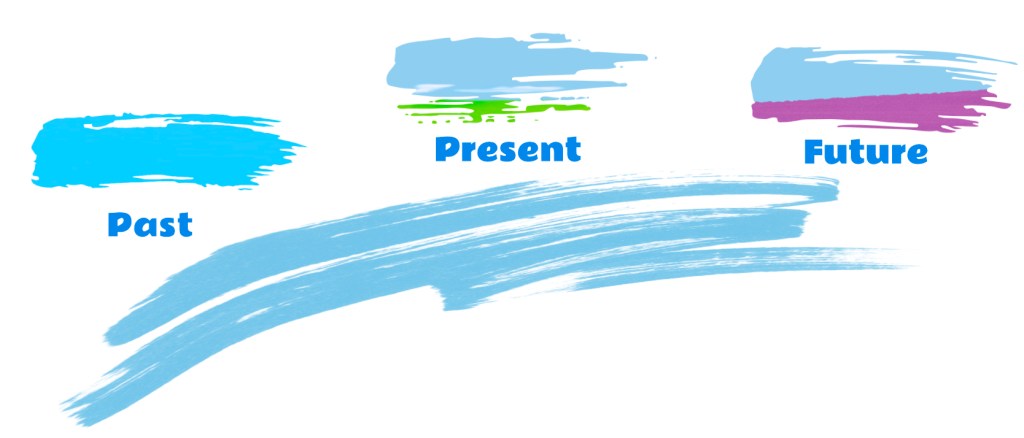
CLASSIC ZERO CONDITIONAL
82. If you eat the cookie, you DO NOT have it for later.
Both the target grammatical time and the language form are the PRESENT.

CLASSIC FIRST CONDITIONAL
83. If you eat the cookie,
you WILL NOT have it.
We thought about the verb form “WILL” in the fields of time at the beginning of the language journey.

The verb form “WILL” maps on the FUTURE already in its PRESENT grammatical shape. We may compare Modal uses:
84. She WILL be reading now.
(I am sure she is reading now.)
In example 83, the target grammatical time is the FUTURE, and the language form is the PRESENT.
83. If you eat the cookie,
you WILL NOT have it

CLASSIC SECOND CONDITIONAL
85. If you ate the cookie,
you WOULD NOT have it.
The target grammatical time is the PRESENT;
The language form is the PAST.
CLASSIC THIRD CONDITIONAL
86. If you had eaten the cookie, you WOULD NOT have had it.
The target grammatical time is the PAST;
The language form is the anchored PAST.

CLASSIC FOURTH / MIXED CONDITIONAL
87. If you had eaten the cookie, you WOULD NOT have it.
The target grammatical time is the PAST for the premise, and the PRESENT for the consequent;
The language forms are, accordingly, the anchored PAST and PAST.
We may view the language form as all the way making a step forward, in its reference to target grammatical time. The regularity holds for all Conditional shapes, so we may conclude there is generally some relativity, between language form and target time reference — for theory making.

PAST forms refer to the PRESENT, and PRESENT forms refer to the FUTURE. It is only the anchored PAST to stay in the PAST. Many resources will have it for an antecedent PAST, but we may agree there is one PAST, as there is one PRESENT and one FUTURE.
Theory making is similar in Polish, Russian, French, and other languages:
if I was, si j’étais, gdybym był/a, если бы я был/а, wäre ich, etc.
Our relativity has nothing to do with ■Whorfianism.
ADVERTISEMENT
Spring Flowing Colors


Classic guidance may advise the First Conditional when probability is high, and the Second for things more probable than those in the Third.
88. If I WERE you, I WOULD . . .
We could label example 88 as the Second Conditional or Unreal Past, yet it conveys zero probability, for the PRESENT, PAST, as well as FUTURE: the likelihood to become another human individual literally and ever really is zero, for everyone.
88a. *I AM you . . . / *You ARE me . . . ?
The classic Third Conditional would tell about least probable events. Example 89 could be yet telling about a prevented thing.
89. If you HAD NOT taken care of it, this handle WOULD HAVE broken off.
(Nothing happened only because we people would not be trying just anything; it happens to try hairdo.)



We could label examples 90 and 90a the classic First Conditional, yet one conveys PROBABILITY and the other CERTAINTY.
90. If you take care of this handle, it MIGHT work.
(The probability is low.)

90a. If you take care of this handle, it WILL work.
(The probability is very high. Taking care of the gizmo is certain to bring a working condition.)

Along with Modal probability or certainty, we may want to regard real time in syntactic structuring. Feel welcome:
■10.1. UNREAL OR REAL TIME.
■This text is also available in Polish.
ADVERTISEMENT
Book format in preparation.
In the first part of the language journey, feel welcome to consider a picture for
■ the grammatical Past, Present, and Future;
■ the Simple, Progressive, and Perfect;
■ infinitive, auxiliary, and head verb forms;
■ the Affirmative, Interrogative, Negative, and Negative Interrogative;
■ irregular verbs and vowel patterns: high and low, back and front.
Third edition, 2025.


The world may never have seen her original handwriting, if her skill was taken for supernatural. Feel welcome to Poems by Emily Dickinson prepared for print by Teresa Pelka: thematic stanzas, notes on the Greek and Latin inspiration, the correlative with Webster 1828, and the Aristotelian motif, Things perpetual — these are not in time, but in eternity.
■Free access, Internet Archive
■E-pub | NOOK Book | Kindle
■Hard cover, Barnes & Noble | Lulu

Psycholinguistics
Linguistics
& Translation
Knowledge gains with good translation
■Public Domain
Translation. com
American English & Polish

Internet Archive,
the free text and image repository
■Feel welcome to use my free materials■
The posters are available to shop online as well.
 GRAMMAR WEBLOG BY TERESA EVA PELKA