Travel in Grammar obviously is not the only place about grammar, and we may get plenty to read, in books or articles. For school or other language courses, we need to work classic grammar guidance. Let us begin with Oxford Dictionaries for verb tenses.
We can have a ■SCREENSHOT or ■LIVE PAGE, for the now Oxford-powered Lexico, to talk the classics.
The website says there a three main tenses in English, the present, the past, and the future. The tense of a verb tells when a person did something or when something existed or happened.
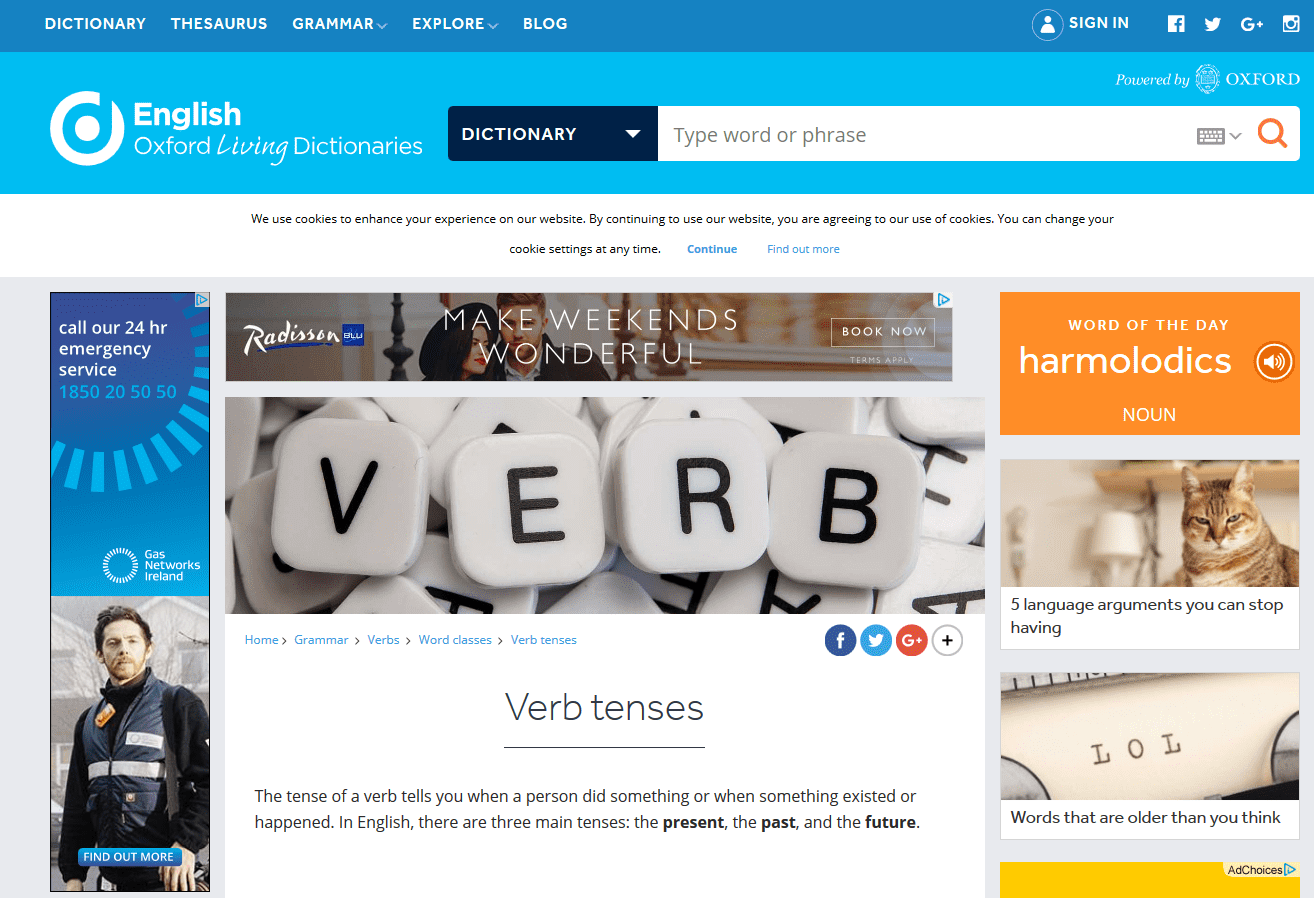
This is trouble enough, we stop here. The trouble is in bold above.
Grammatical tenses are not clocks or chronicles. They do not tell when. For the date, hour, or another circumstance we use mostly prepositions and nouns, whereas we tell the tenses in verbs.
We met at nine, the Simple Past tense.
We will have done all by twelve, the Future Perfect tense.
Feel welcome to our code for parts of speech. Some people will say that words as nine or twelve are numerals strictly, but granny thinks that round the clock it is not as much of a number. Up to 24, these can stand for the hour, and the word hour is a noun.

Colors can help learn, read and write
The Travel begins with verbs, as in natural acquisition and learning. Verb auxiliary roles are marked in green, and head roles are mauve. Pronouns and nouns are ink blue. Highlights are forget-me-not, blue. We avoid color red, as it usually brings prescriptive opinion on language. ■More

There are about 12 grammatical tenses in English, if we combine the Aspect, Simple, Progressive, Perfect, and Perfect Progressive — with grammatical time, PRESENT, PAST, and FUTURE. The multiple of the four and the three is a nice, round numeral: twelve.
Granny knows some languages that do not have verb Aspect. In those languages, people may say they have three tenses, Present, Past, or Future. Those languages can translate and express verb Aspect, only with words other than verbs.

Appendix 1. Verbs and what they do
Verbs tell activities, faculties, or states, as to think, to work, or to be. They may do this in four Aspects, the Simple, Progressive, Perfect, and Perfect Progressive; intransitive or dynamic, in infinitives or participles — where Modals are exception in much, and yet legitimate verbs of a frame. ■More
Languages that do not have verb Aspect may have noun flexions, as Polish or Russian. Other languages may build words like from chunks, as they do in Hungarian or Chinese to say they have two or no tenses at all. If there is no thing of one sort, there is another, so mind workload is more or less the same in every language, and the difference is in language form, not in mind ability.

Language form, as with cats and dogs
Different languages have different ways to name objects of thought. We can say a dog in English; in German ein Hund, in French un chien, in Greek σκυλος, and in Russian собака — whereas at the same time and in all languages, a picture of a cat is not a cat. ■More
Mind evolution must have been at liberty for those language form developments when early people made early grammars, says granny, so she continues to keep an open mind, because languages are probably the greatest, in human progress. Without tongues, math would be mere number; physics and chemistry in strife for letters too — if sciences would have emerged at all.
Granny is back with the Lexico, who say that tenses tell if something existed OR happened.
She has looked up the Lexico itself, for the word ■OR, and the word is to tell alternatives, synonyms, or afterthought.
For an ■ALTERNATIVE, granny can tell from living experience that non-existent things don’t happen, and things that exist may never happen in our lives, so existence and happening are not ■SYNONYMS, whatsoever. More, in football and baseball games, there happens a lot, and it’s no ■AFTERTHOUGHT.
Well, we couldn’t have to go ■THE PHILOSOPHER, to read online advice. The Lexico example does not show an alternative, synonym, or afterthought. It uses ■APPOSITION, as things may happen and exist too:
What are you going to have for your vitamin C?
Orange, lemon, or grapefruit (all of these have the vitamin and differ in taste).
Granny says, whatever advice you read, and grammar is important because it is part in how we people make own thought — think what there is in reality. Some people will say that time does not really exist, because it is neither weight nor depth. Other people will talk about time travel. The reality is, that people all around the world use an idea as time in everyday living, therefore time is.
There is a way to mark grammatical time in all languages, because people need that to talk about life. Granny says, Time or the grammatical time, it is no clock. When she tells what she heard over the World Science Festival, she talks all grammatical time at times, though she saw it in the Past.
Feel welcome to the stories about Time here, and if you’re curious, see some talk on the World Science Festival, about physics and time.

Chapter 3. Time is like a river: verb patterns
Everyday language has phrases as a flow of time, a course of events: we people happen to have such impressions about life. Grammatical patterns for words and time may look a lot to think about at first, and this is why we begin with a good glimpse. ■More

Chapter 4. Aspect cognitive variables
Humans naturally build mind perspectives for neighborhoods or vicinity, in familiar settings. Since the very beginning, people have lived in places that allow the horizontal plane: to sit, have meals, sleep; read, write, or paint. Human grammar has evolved on planet Earth. ■More
 GRAMMAR WEBLOG BY TERESA EVA PELKA