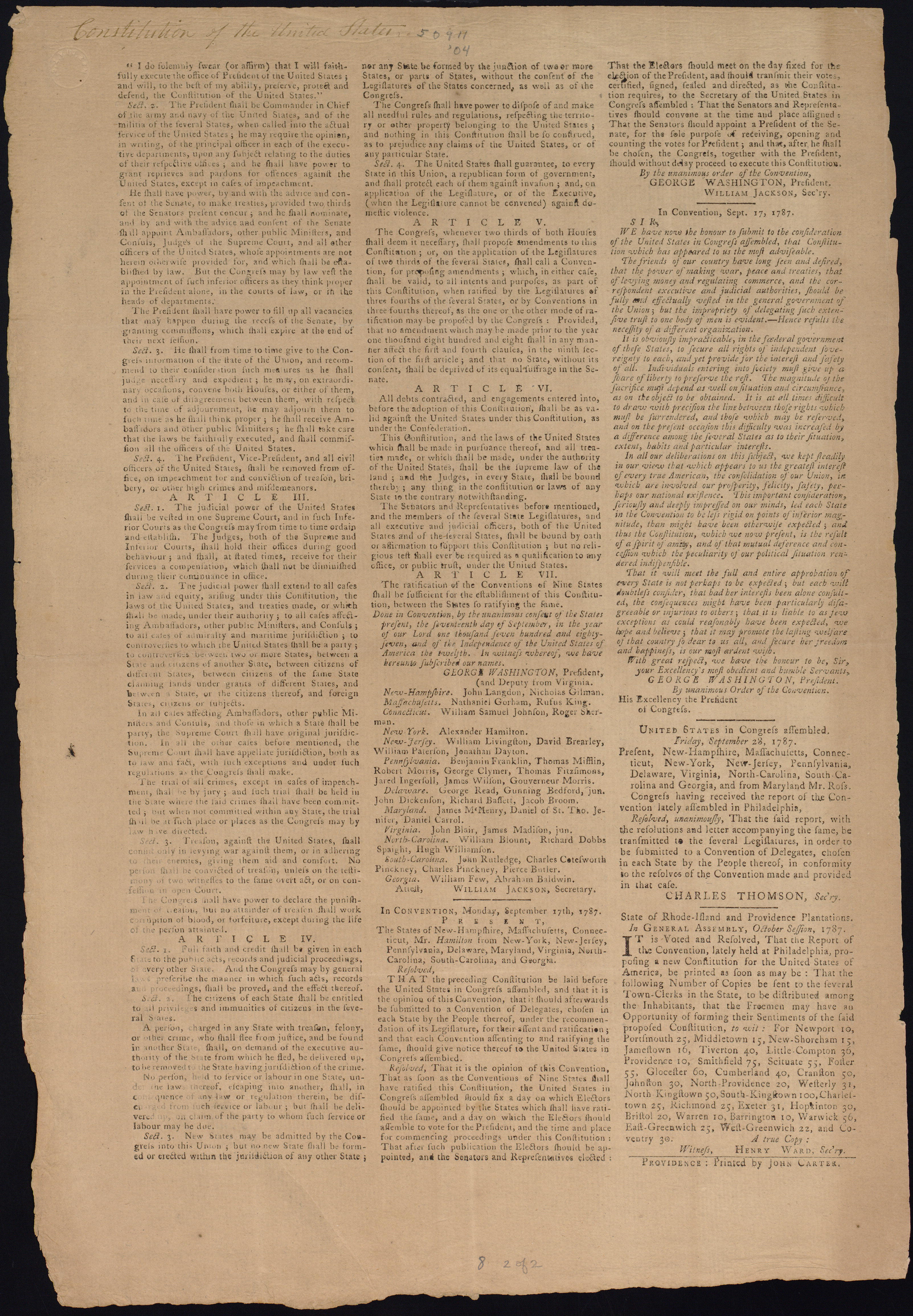
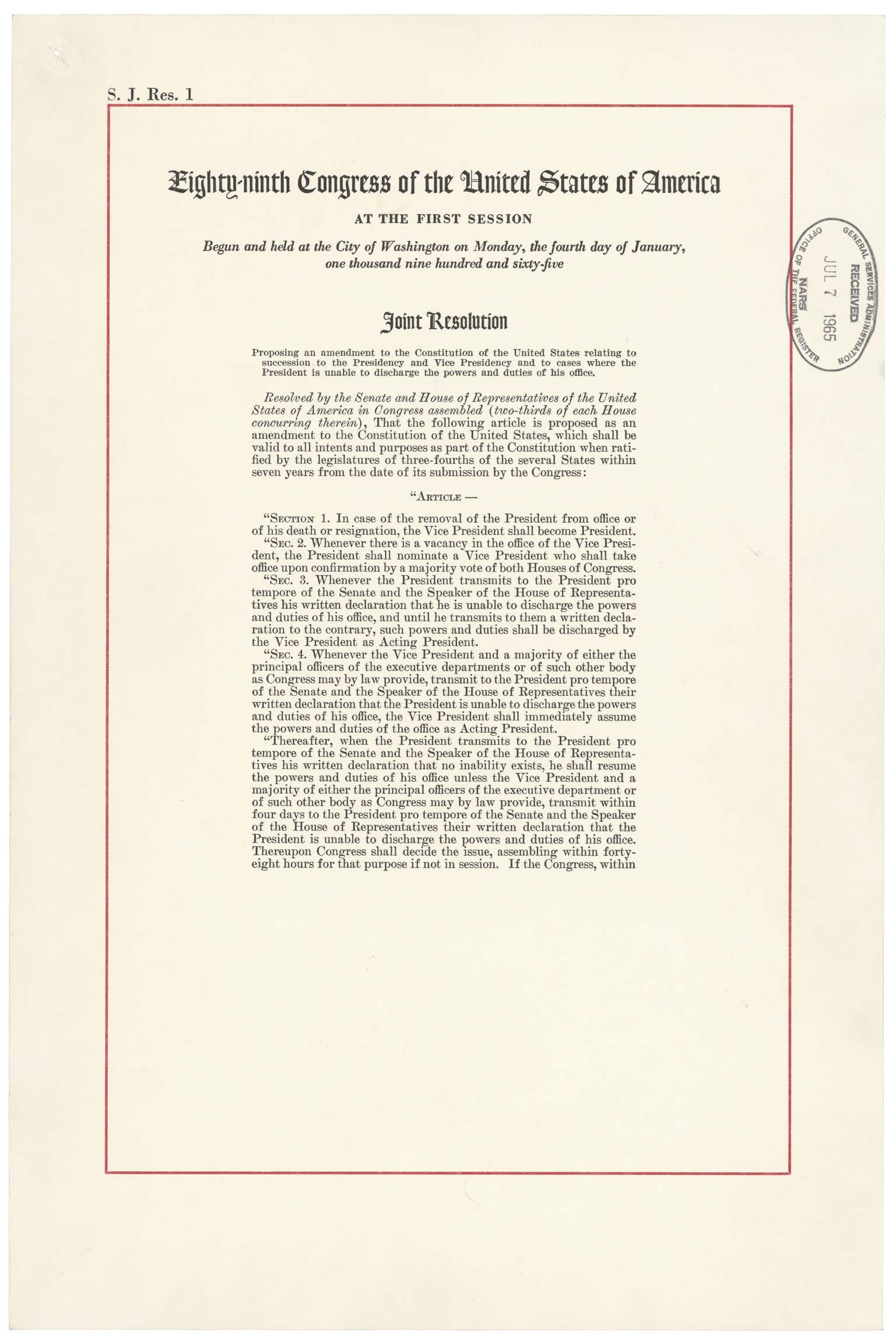
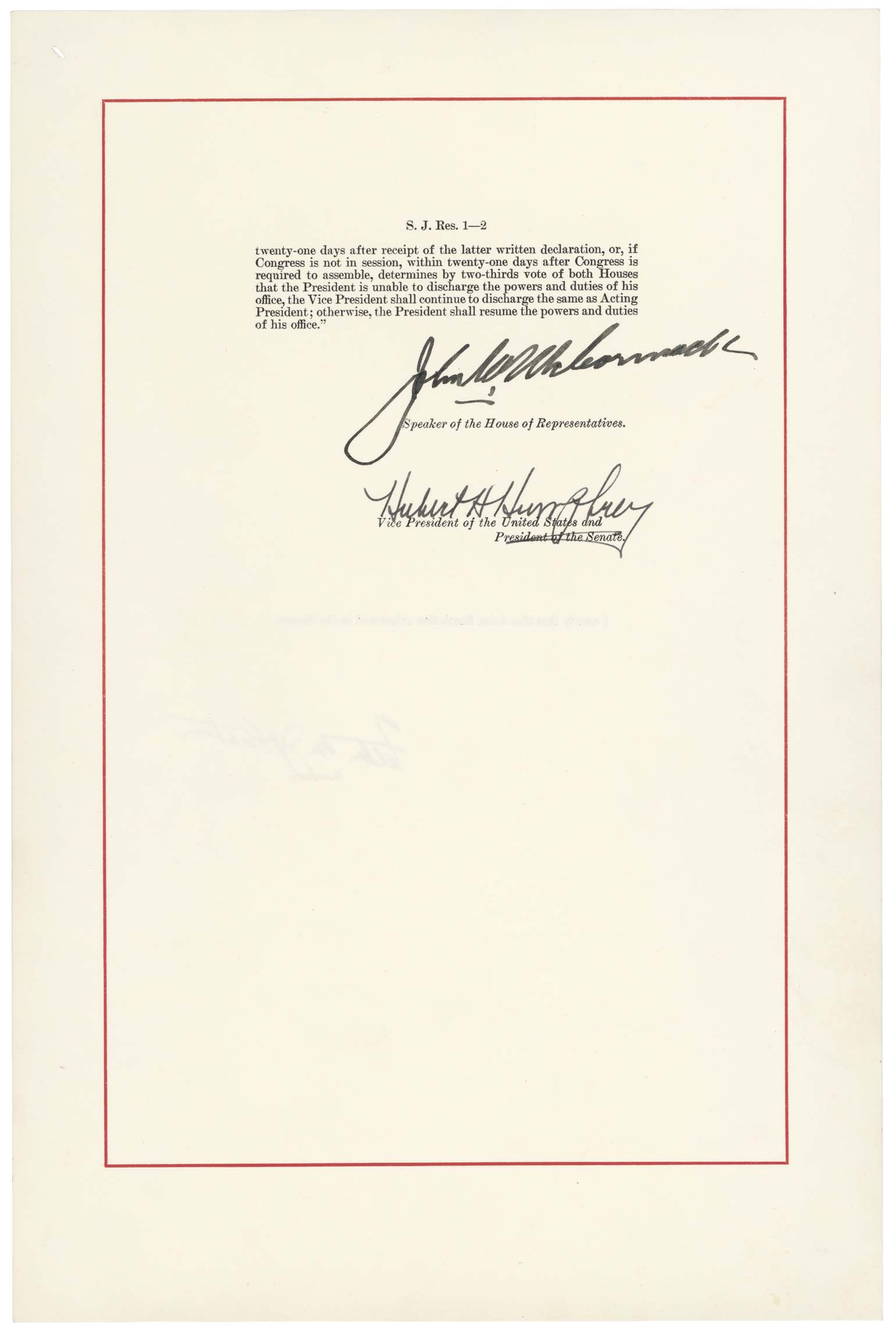
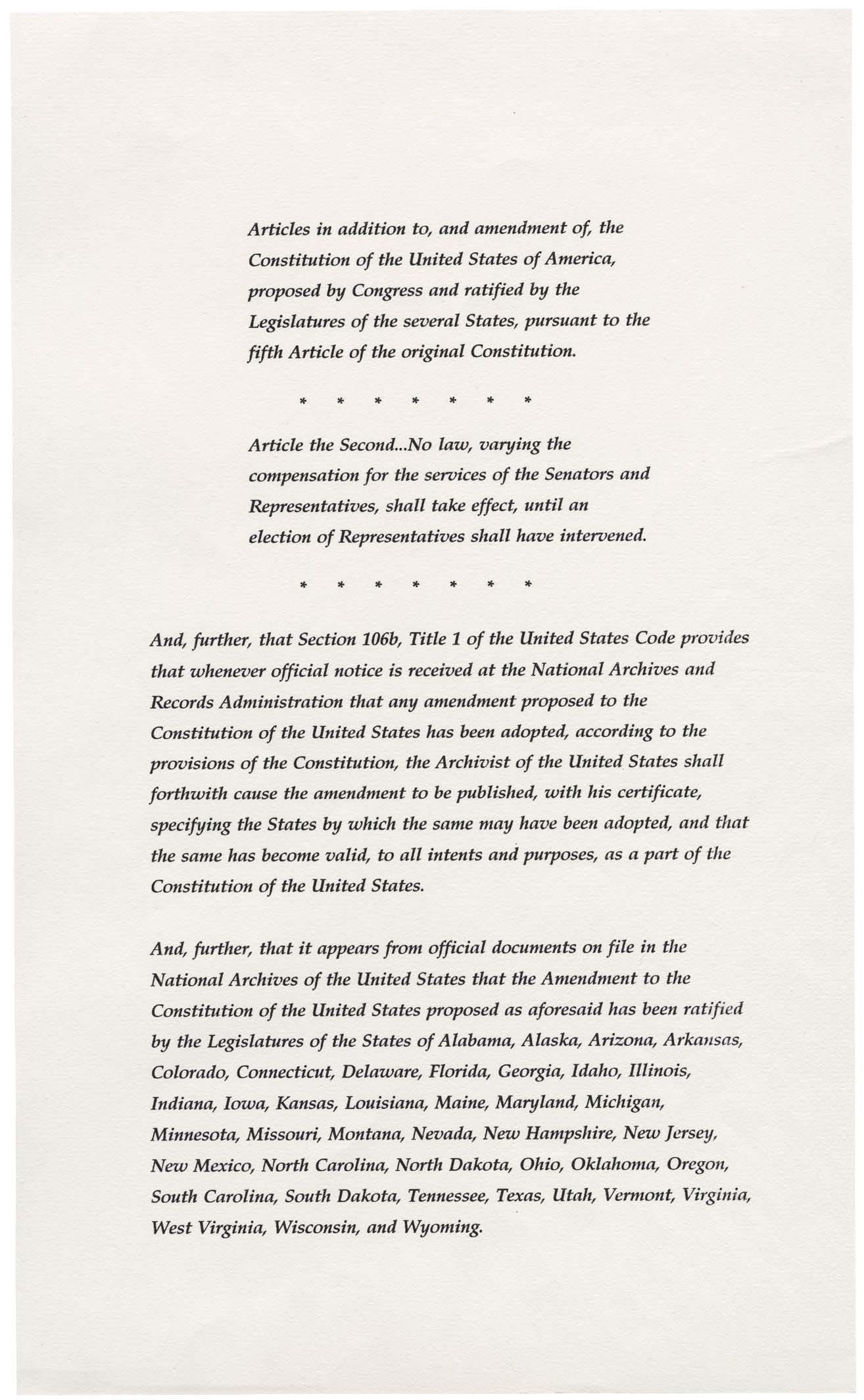
The John Carter layout is very legible: words are divided as to help get around the text, where you could say the word-dividing dash is almost “interstate”. The civics are great for the grammatical articles and syntax, hence the update: for grammar today.
Updating or curating text is to bring the content to the time. It is not to correct or outdo the original — even how? As in a story of time travel, imagine you are in the US of the Declaration time. Your 21st century English would be controversial, because it would be odd. You’d need to learn the shapes people approved at the time.
Therefore, let us not deny the civics their appeal. We can have them in the shapes of today. The update here is spellcheck error-free, according to the present American English standard, all updated from internal evidence — this has been possible because the US has not followed in prescriptivist tracks, for language education. The written matter is a bonanza of the grammatical article and syntax. We may take the read a bit at a time.
Jump to Carter Layout Page 1
Jump to Carter Layout Page 2
To tell everything, we may need to state on the obvious: the civics have been written over hundreds of years, as amendments, and their text shows that keeping a language style of the 18th century has not been the purpose — of course. All my resources are enclosed here.
National Archives, ■The Constitution,
The Library of Congress, ■John Carter print,
US Senate, ■Constitution of the United States.
Downloads, original document facsimiles:
■Constitution Parchment Page 1, Constitution Parchment Page 2, Constitution Parchment Page 3, Constitution Parchment Page 4 ,
■John Carter Print Page 1, John Carter Print Page 2.
BILL OF RIGHTS, AMENDMENT XI, AMENDMENT XII, AMENDMENT XIII, AMENDMENT XIV PAGE 1, AMENDMENT XIV PAGE2, AMENDMENT XV, AMENDMENT XVI, AMENDMENT XVII, AMENDMENT XVIII, AMENDMENT XIX, AMENDMENT XX PAGE 1, AMENDMENT XX PAGE 2, AMENDMENT XXI, AMENDMENT XXII, AMENDMENT XXIII, AMENDMENT XXIV, AMENDMENT XXV PAGE 1, AMENDMENT XXV PAGE 2, AMENDMENT XXVI, AMENDMENT XXVII PAGE 1, AMENDMENT XXVII PAGE 2, AMENDMENT XXVII PAGE 3.
Another statement on the obvious may come with reading Henry David Thoreau, where I enclose an important reservation, to my translation of his Disobedience:
In Henry David Thoreau’s time, supporters of slavery invoked the Constitution. Here Daniel Webster (1782 – 1852, another Webster, not the dictionary one) is quoted on page 96, “Because it was a part of the original compact, — let it stand”. Slavery never was part the agreement to make the Union. “The Constitution we now present” — was to George Washington’s eyes the seven original articles. The Bill of Rights made no promise to the slave owner.
The Constitution has a language shape as “to import”: some Americans helped their family or friends, hence the Latin im-porto may tell, to bring in. The government had no business with ship owners or people traders in Africa. Whether the habeas corpus, or the provision against attainder, neither would exclude slaves; and no such exception is made in the requirement for the Grand Jury. The original compact did not and does not provide for slavery or slave owners.
The Constitution preamble:
The word shape defence is associated with British English today, whereas defense is standard American English. The updated preamble says, to provide for the common defense. All the update is American English of today.
The body:
Article I Section 2. Electors written with the big letter might mean select people, as those for the Electoral College. The update has electors, to mean US citizens in general elections. At the time the Constitution was written, words often were capitalized just because they were nouns.
Congress or the Congress: the definite article, the, may indicate one of the three, the Legislative, Executive or Judiciary, or the Congressional body as at the time: Congress has not been composed of the same people throughout.
The grammar ■Modal Net introduces to the articles and time. There is a simple idea to begin part 3 of the grammar course: altogether, we can use noun word shapes with the indefinite article, no article, or the definite article.

We say ˹ the Congress when the word is of reference in the body of text. There is a simple idea to explain reference, ˺ an ink cat. To describe ˹ the cat, we could use the adjective black, for ˹ the print color. We say the cat, the definite article: though the cat has not been yet described; it has been of reference. Our knowledge of the context is part in making that reference, as we can see by the phrase, ˹ the print color. Actual symbols to show reference naturally are up to individual choosing, as ⌈ ⌉ └ ¬ ┘˹˺.
The first amendment says ‖ Congress, without the article, as the article might imply that if the Congress does not do so, that is, does not decide on establishment of religion, the Judiciary or Executive might, because they are of reference. The word sense yet clearly is, law can be made only in Congress, and there cannot be law to decide religion.
Legal texts especially would be interpreted as bodies of written matter, hence the articles, clauses, and the legal profession. I have taken up reading the Constitution as a self-respecting linguist, and I really like it.

My updated print has all amended text marked out as ¯||¯, because the reference is no more, the text is not the Constitution:
The Congress shall assemble at least once in every year, and such meeting shall be
on ||¯ the first Monday in December, ¯|| unless they shall by law appoint a different day.
The update Executive is capitalized just the same as the Speaker or Chief Justice, to highlight the Tripartite.
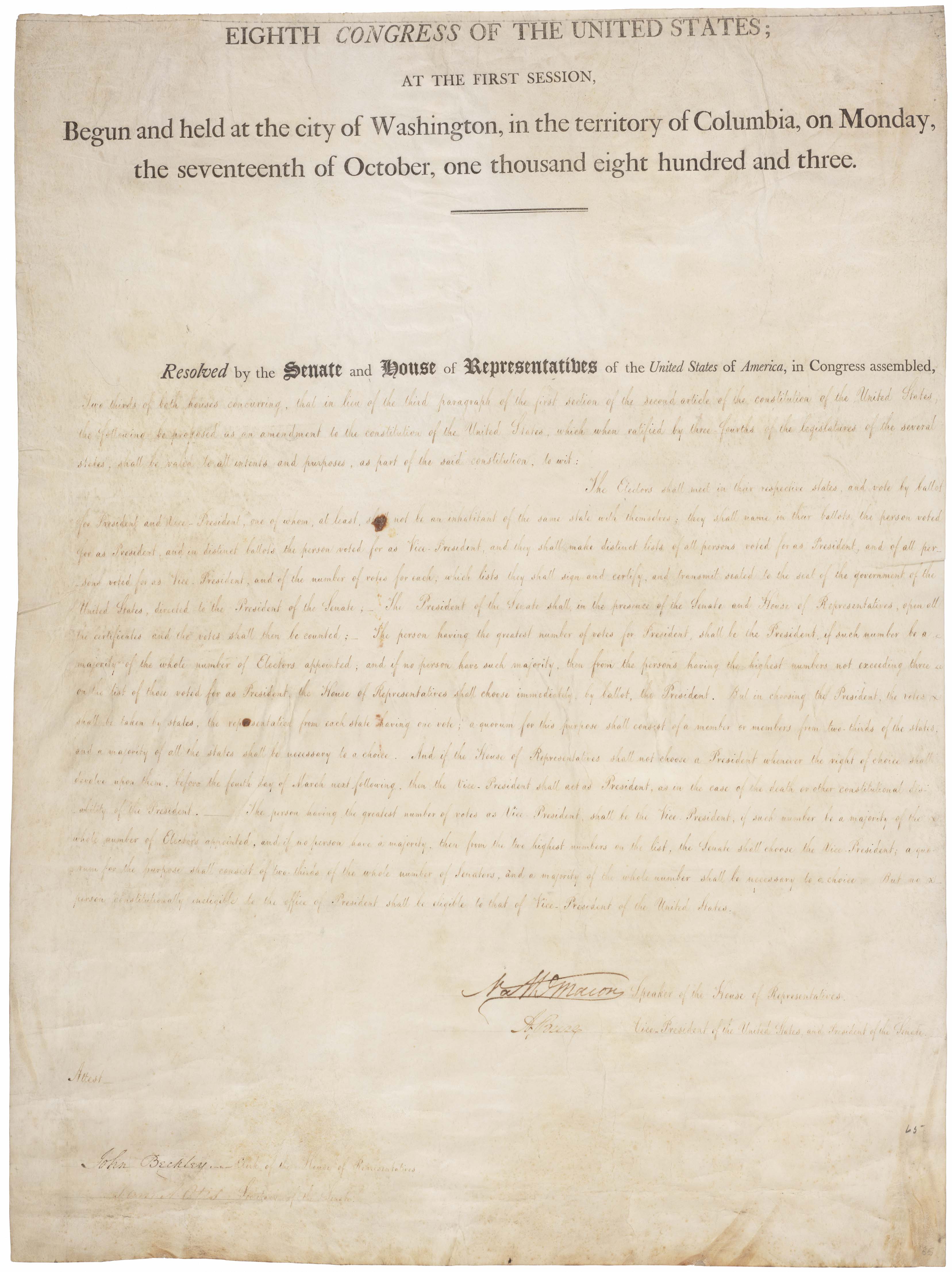
“The death of the President”: the grammatical article was mostly phrasal in English those times, that is, if there was “of”, people did put “the”. The ■12th Amendment says, in the case of the death or other constitutional disability of the President.
The Framers mostly adapted to the phrasal habit, as disputes over grammar are not anything you need when you want a constitution ratified. ■Carter yet has the case of removal, death, resignation; ■the parchment original shows the same, and this is the pattern I follow in my update. ■John Carter, the printer, was Benjamin Franklin’s apprentice, and amendments obviously never have been to do away with language.
Why the Constitution does not say in case — it says in the case — is understandable: no President could be just removed; there needs to be a legal and formal proceeding that recognizes an issue, hence the case of removal; death would result in procedural replacement, as well as resignation.
It is the original Constitution to say a Congress, a House of Representatives and a Senate, proving the articles have been generative in English quite long.
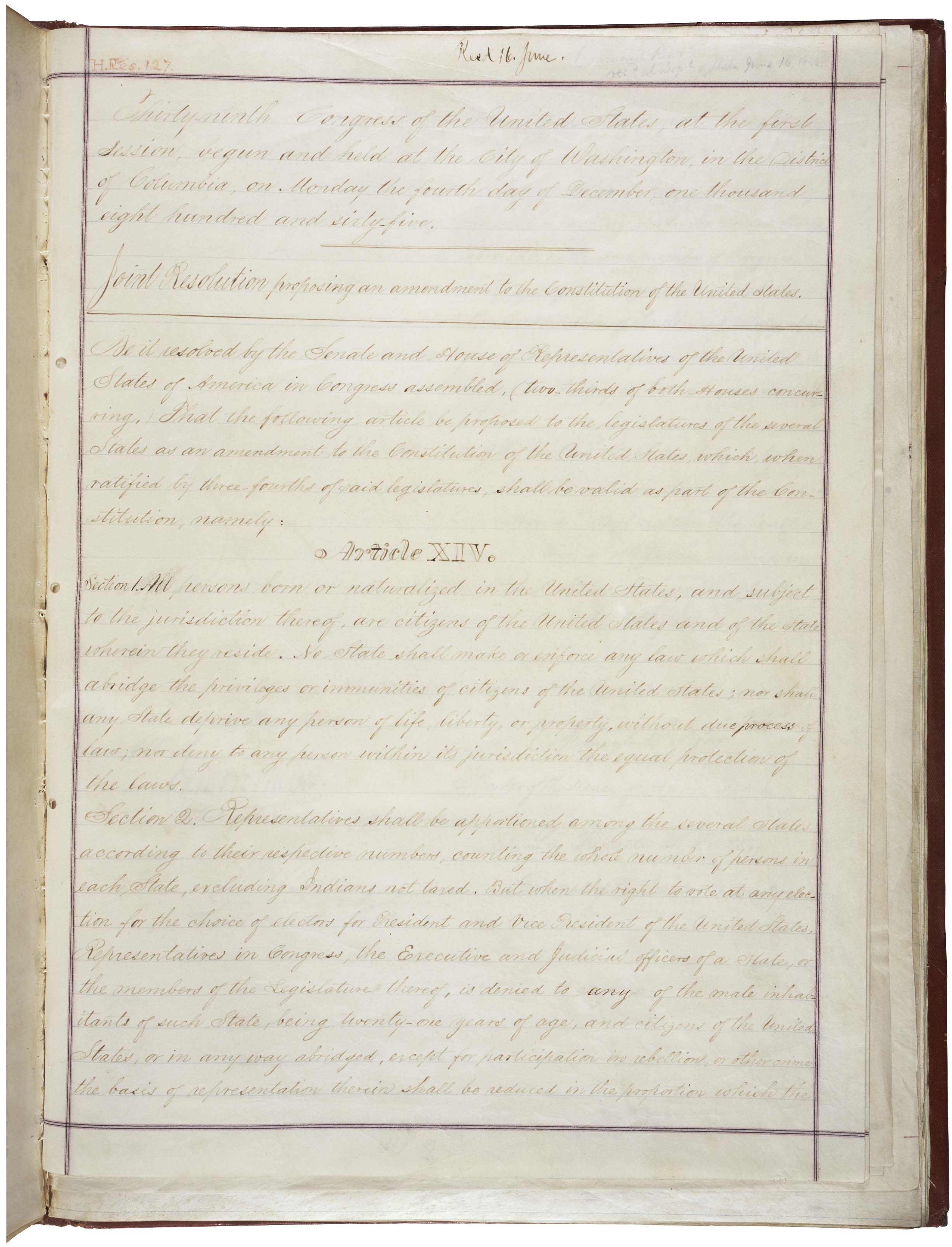
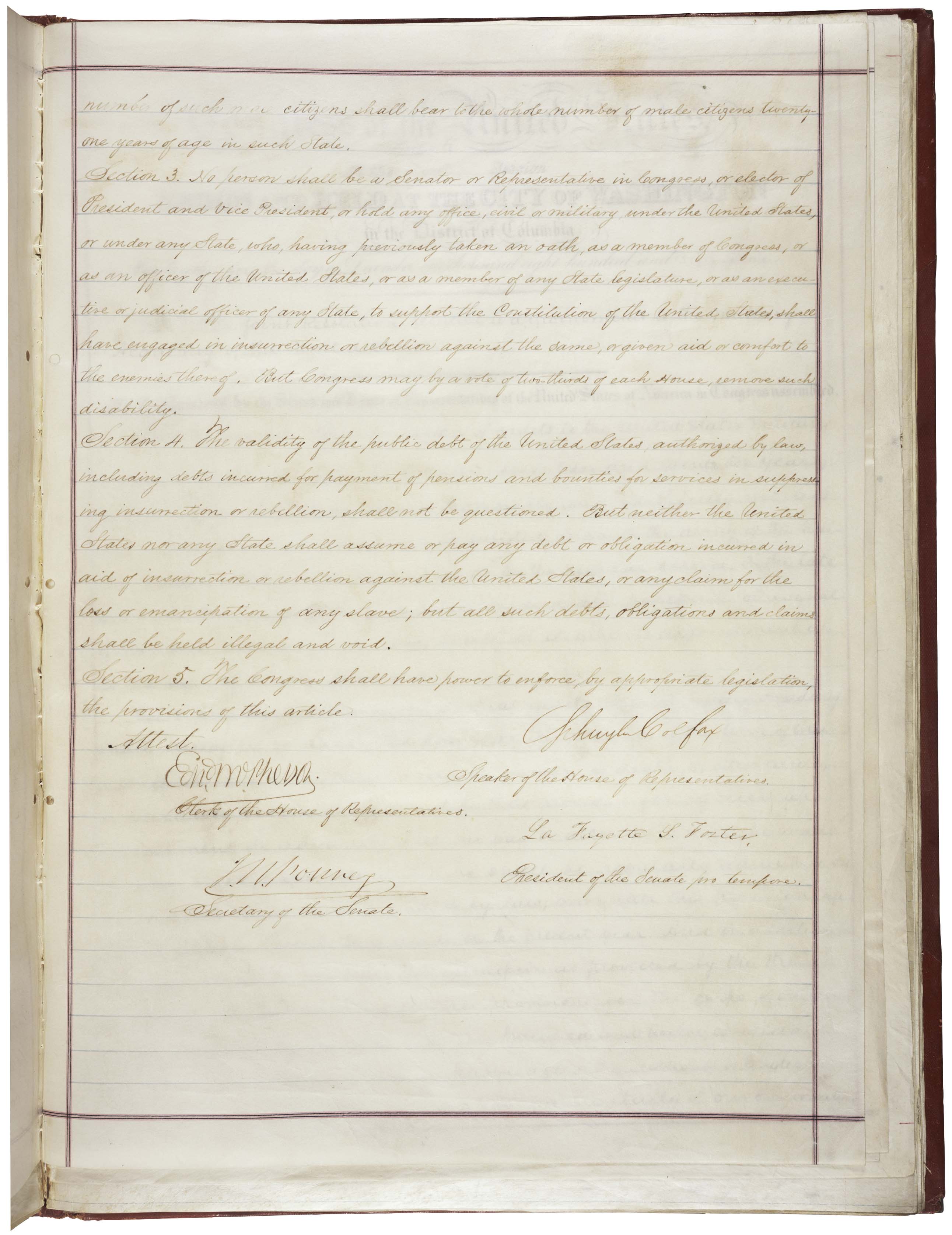
It was probably the definite article to encourage the 14th amendment: All persons born or naturalized in the United States, and subject to the jurisdiction thereof, are citizens of the United States and of the State wherein they reside.
We may look up Article IV Section 2: The citizens of each State shall be entitled to
all privileges and immunities of citizens in the several States. The definite article might suggest a kind or type of people, hence the 14th amendment would say, All.
Article III Section 2 has the definite article only to tell between the people and the government: to controversies between between a State and citizens of another State, between citizens of different States, between citizens of the same State claiming lands under grants of different States, and between a State, or the citizens thereof, and foreign States, citizens or subjects.
The updated Article IV Section 2 says, Citizens of each State shall be entitled.
The matter is similar with the phrase “the Judges”, as it occurs in Article III, the Judges, both of the Supreme and Inferior courts shall hold their offices during good behavior; or Article VI, the Judges in every State shall be bound thereby.
The expectation obviously never was for select judges only to follow good behavior, and Article VI itself adds, all executive and judicial officers, both of the United States and of the several States, shall be bound by oath or affirmation, to support this Constitution.
With phrases as all people you could say people as well. The phrase judicial officers would embrace judges, where all judges would be generally judges — a/any judge in the singular.
My update capitalizes the ■Tripartite (the Legislative, Executive, Judiciary, Articles 1-3): The Senators and Representatives before mentioned, and members of the several State Legislatures, and all Executive and Judicial officers, both of the United States and of the several States, shall be bound by oath or affirmation, to support this Constitution; judges in every State shall be bound thereby, anything in the constitution or laws of any State to the contrary notwithstanding.
In Article III, Judges, both of the Supreme and inferior courts, shall hold their offices during good behavior.
“Cession and acceptance”, Article I Section 8: Carter print would have the acceptance, yet we may compare Article IV Section 4:
The United States shall guarantee, to every State in this Union, a republican form of government, and shall protect each of them against invasion; and, on application of the Legislature, or of the Executive (when the Legislature cannot be convened), against domestic violence.
Article V tells about legal prediction for potentially repeated action, unlike in cases of domestic violence, because violence is not a procedure (obviously).
The Congress, whenever two-thirds of both Houses shall deem it necessary, shall propose amendments to this Constitution; or, on the application of the Legislatures of two-thirds of the several States, shall call a Convention for proposing amendments.
My update has cession and acceptance, and not the acceptance, as there are no predictions for the District repeatedly to become formed again.
Please mind, I do not mean to criticize styles. Times change, and we change with them — it is a very olden saying, and I agree with it.
Updated Article IV: no new State shall be formed or erected within the jurisdiction of any other State; nor any State be formed by a junction of two or more States, or parts of States, without the consent of the Legislatures of the States concerned, as well as of the Congress.
In every country there is standard measurement for land and water, and a classic phrase as the junction might suggest today some special piecing together that the law predicts and does not want done — without telling what it would be in the body of text — whereas a junction is plain, clear, and definitely not an error, as the Congress is anyway expected to resolve for every case individually.
We do not need to guess intention, in grammar. It is enough we do not go into error.
The Civil War broke out over the South seceding without Congressional approval. The issue was slavery and other finance, where Southern representatives wanted to keep slaves, and the North felt tariffs were not good enough to improve economy, wanting abolition. British involvement became proved beyond doubt in the Trent Affair, and I believe the North or “Yankees” had no choice but to go to war. Slavery was abolished by the “Yankee President” Abraham Lincoln, who never was doubted on the Constitution.
USA economy never suffered from the abolition. Slave purchasing power can be only zero, and no tariff could make up for the fact. Turnover is crucial in free market economy, which Roosevelt New Deal emphasized all the more. I describe this in another post.
The word “but” occurs at Constitution sentence beginnings, and today you are told not to do so, yet it is a body of legal text with clauses, where it is simply most efficient to use the word. All my updates keep it.
The images here have all the markup for the Constitution Carter layout, compared with the parchment.
Carter Layout Page 1
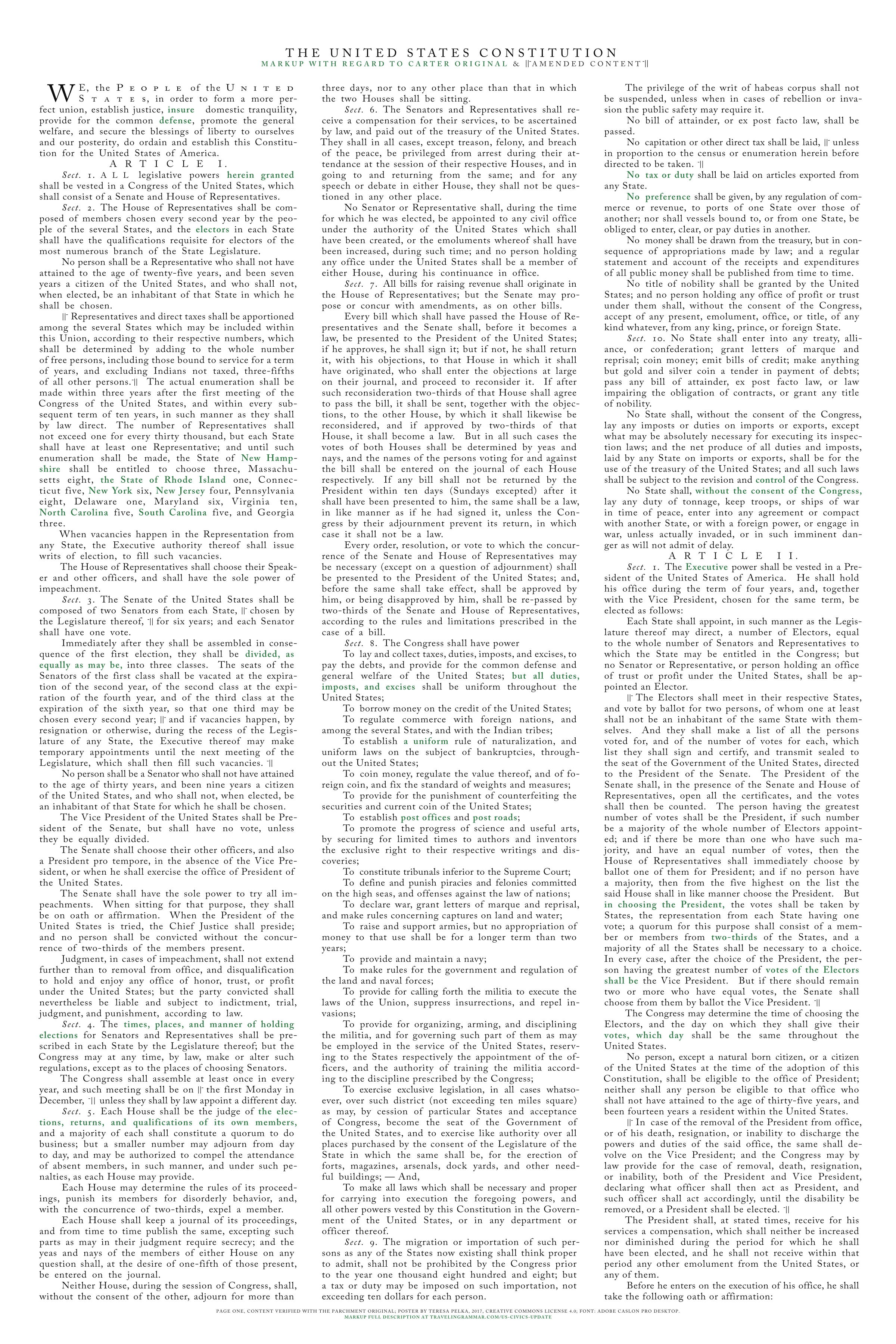
■ to form a more perfect union, establish justice, insure domestic tranquility: insure as in the parchment; Carter ensure was printed in the time people also wrote enquire; ensurance is an obsolete form today; pragmatically, a print on a wall cannot real-time or immediately ensure: only active people could do that; the more extended time perspective in which the Constitution works much of the time, people can effectively argue about the rights in case, and this is a greatest insurance ever;
■ provide for the common defense: the spelling of today;
■ legislative powers herein granted: the parchment does not separate the phrase with commas, and they are not indispensable;
■ the qualifications requisite for electors: small letter, as different from the Electoral College;
■ New York, New Jersey, North Carolina and South Carolina: state names are no longer spelled with dashes;
■ they shall be divided, as equally as may be, into three classes: commas for clarity and emphasis, more like the syntax of today;
■ any office of honor, trust, or profit: today, honour is associated with British English more, and the parchment spelling is honor;
■ The times, places, and manner of holding elections for Senators and Representatives shall be prescribed in each State: punctuation as today;
(original Carter: The times, places and manner, of holding elections for Senators and Representatives, shall be... | parchment: The times, places and manner of holding elections for Senators and Representatives, shall be…);
■ Each House shall be the judge of the elections, returns, and qualifications of its own members, and a majority… : punctuation as today;
(original Carter: Each House shall be the judge of the elections, returns and qualifications, of its own members, and a majority… | parchment: Each House shall be the judge of the elections, returns and qualifications of its own members, and a majority…);
■ civil office under the authority of the United States which shall
have been created, or the emoluments whereof… : a defining clause as today;
(original Carter and parchment: any civil office under the authority of the United States, which shall have been created);
■ the emoluments whereof shall have been increased: the language has changed from shapes as encreased, both in Carter and the parchment;
■ If after such reconsideration two-thirds of that House shall agree: the spelling of today uses the dash for proportion;
■ but all duties, imposts, and excises shall be… : punctuation as today;
(original Carter: but all duties, imposts and excises, shall be… | parchment: but all duties, imposts and excises shall be);
■ To establish a uniform rule of naturalization: the language has changed in sounding from an history, an uniform;
■ To establish post offices and post roads: the language has changed from spelling as post-office, post-road;
■ To exercise exclusive legislation, in all cases whatsoever, over such district (not exceeding ten miles square) as may, by cession of particular States and acceptance of Congress, become the seat of the Government of the United States: the matter is not that of predicting on repeated activity, as the Constitution does not provide for another place becoming the seat of the government; (original Carter and parchment: cession and the acceptance);
■ No tax or duty shall be laid on articles exported from any State.
No preference… : distinct paragraphs as in the parchment;
■ and all such laws shall be subject to the revision and control of the Congress: spelling has changed from the shape controul;
■ No State shall, without the consent of the Congress, lay any duty of tonnage… : the parchment has a correction, the Congress, and the effect would be co-temporaneous anyway: business would not act in expectation that next Congress agrees to tonnage as there is now.
Article II.
■ The Executive power: highlight on the Tripartite, the Legislative, Executive, and Judiciary.
■ But in choosing the President, the votes shall be taken… : the parchment has the comma, and it does agree with the punctuation as today;
■ the person having the greatest number of votes of the Electors
shall be the Vice President: the parchment has no comma, and it is not indispensable;
(original Carter: the person having the greatest number of votes of the Electors, shall be the Vice President);
■ and the day on which they shall give their votes, which day shall be the same throughout the United States: punctuation as today, a comma rather than the semicolon, Carter and parchment;.
■ neither shall any person be eligible to that office who shall not have attained to the age of thirty-five years: a defining clause as in the standard of today, and in the parchment already.
Carter Layout Page 2

■ I do solemnly swear (or affirm) that I will faithfully execute the office of President of the United States, and will, to the best of my ability, preserve, protect, and defend the Constitution of the United States: Carter has the semicolon where the parchment comma would be more usual today; I keep the Carter comma after the verb form will, for emphasis;
■ the Executive departments: capitalized for the Tripartite;
■ pardons for offenses: spelling as in American English today;
■ provided two-thirds of the Senators present concur: the spelling standard of today;
■ public ministers: not specific enough with regard to the Tripartite, not capitalized;
■ all other officers of the United States whose appointments… : a defining clause as today;
■ But the Congress may by law vest the appointment of such inferior officers as they think proper, in the President alone, in courts of law, or in heads of departments: courts and heads are named for their prerogatives; the use is more as for Congress in the first amendment; the President, naturally, is the one in office as elected for a term of years;
■ on impeachment for and conviction of, treason, bribery: the comma as in the parchment and punctuation today as well;
■ The Judicial power of the United States: Tripartite capitalization;
■ and in such inferior courts: the Tripartite does not operate on inferiority; it functions on prerogatives;
■ Judges, both of the Supreme and inferior courts: Carter and parchment definite article dropped, to avoid associations with type or selection as described above;
■ public acts, records, and judicial proceedings of every other State: closer to punctuation as today, the parchment does not have the Carter comma;
■ Citizens of each State shall be entitled to all privileges and immunities of citizens in the several States: Carter and parchment definite article dropped, to avoid associations with type or selection as described above;
■ A person charged in any State: the parchment does not have the Carter comma;
■ No person held to service: the parchment does not have the comma;
■ valid to all intents and purposes as part of this Constitution: punctuation as usual today;
(original Carter: which, in either case, shall be valid, to all intents and purposes, as part of this Constitution; || parchment: which, in either case, shall be valid to all intents and purposes, as part of this Constitution);
■ Provided that: the parchment does not have the comma, and punctuation as usual today would agree as well;
(original Carter: Provided, that);
■ and judges in every State shall be bound thereby: individually as officers; capitalization might form some redundancy, as in context all judges are part the Tripartite, no one else can legally judge; the definite article is dropped as above, also for judges. We may compare,
■ The Senators and Representatives before mentioned, and members of the several State Legislatures, and all Executive and Judicial officers, both of the United States and of the several States, shall be bound by oath or affirmation, to support this Constitution: the capitalization is for a type of country function;
■ year one thousand seven hundred and eighty-seven: year of our Lord is not the date format anymore.
Where the typesetting encourages, words are arranged according to space in line, without change in content, as in the two paragraphs of Article V above, or in Article I, for distinct paragraphs on State powers under Congress.

The State of Rhode Island required a bit of equilibristic, as the people dropped the “Providence Plantations” from the name, and I think departure from reminiscences of slavery is very cool. Fortunately the typesetting has allowed the State of Rhode Island along with the scope in lines. The people likely would use the present name for talking the political history too, rather than invoke “the times we were plantations”, as even none has been those, of the living.
Dealing with the history may not be easy. George Washington owned slaves; to throw his merits away yet would not be a balanced approach: it was him as well, to propose the Constitution that did not except slaves from privileges as the habeas corpus, and those never have had citizenship for a condition. The change in people likely began with this legal equality.
The Constitution is founded on thoughts about democracy and liberty. The world was not quite up to it in the beginning, yet the world has made progress — with the Constitution.
Carter print of George Washington’s letter has spelling updated to advisable, indispensable, and honor; punctuation: situation, extent, habits, and particular interests, as is regular today.
Carter printed the Rhode Island resolve in the style of the parchment, that is, nouns and forms derived from nouns are capitalized: It is Voted and Resolved where the Vote and Resolve is the basic reference. The markup has it all.
The matter is different with the Congressional resolve right above, where the People are capitalized as a factor. I stay with the Tripartite, the Legislative, Executive, and Judicial, where the people are citizens and electors.
I do not change or alter the “page economy”, that is, resolves printed as beginning with That, big letter, remain as they have been. Printing them in separate paragraphs for the sake of the big letter is not really necessary — obviously.
 GRAMMAR WEBLOG BY TERESA EVA PELKA