For school or other courses, we need to work classic guidance. Let us begin with Oxford Dictionaries for verb tenses. We can use a ■SCREENSHOT of the Oxford-powered Lexico.
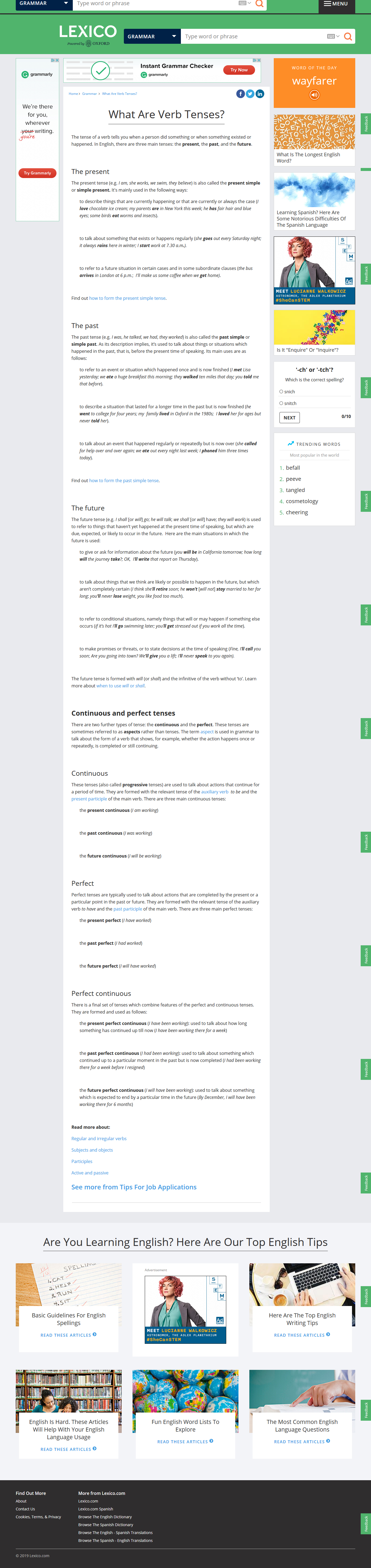
The website says there are three main (1) tenses in English, the present, the past, and the future. The tense of a verb tells (2) when a person did something or when something existed (3) or happened.
This is trouble enough. We stop here. The trouble is underlined.
1. The Present, Past, or Future are the grammatical time, or Time for short. You could say these are tenses in languages that do not use verbs to express the Aspect, but those languages themselves might not care.
In Polish you have the Present, Past, or Future ■czas, and the word is the same for time or tense because there is no need to tell the difference. The language marks the circumstance otherwise.
In English, a tense is Time and Aspect, as Present Simple or Past Perfect.
There are 12 grammatical tenses in English, if we combine the Aspect, Simple, Progressive, Perfect, and Perfect Progressive — with grammatical time, PRESENT, PAST, and FUTURE. The multiple of the four and the three is a nice, round twelve.
Some people will have a Future in the Past or Unreal Past, but these do not make it within our framework, where a tense is Time and Aspect strictly. For other things we have ■Form relativity.
2. Grammatical tenses are not clocks or chronicles. They do not tell, when. For the date or the hour we use mostly prepositions and nouns, whereas we tell the tenses in verbs.
We met at nine, the Simple Past tense.
We will have done all by twelve, the Future Perfect tense.
Feel welcome to our ■color code for parts of speech.

Some people will say that words as nine or twelve are numerals strictly, and numerals would be classed with adjectives too, but granny thinks that around the clock it is not as much of a number. Up to 24, these can stand for the hour, and the word hour is a noun.
3. Granny is back with the Lexico for things that existed OR happened. She has looked up the Lexico itself, for the word ■OR, and it is to tell alternatives, synonyms, or afterthought.

For an ■ALTERNATIVE, granny can tell from living experience that non-existent things don’t happen, and things that do exist may never happen in our lives, so existence and happening are not ■SYNONYMS. More, football or baseball, there happens a lot and it is no ■AFTERTHOUGHT.
What the Lexico shows really is ■APPOSITION. Objectively, things happen and exist. Without their happening, we cannot tell if they exist, and without their existing they cannot happen. Philosophies have been written about this, and psychologies have flourished on the difference between the objective and the subjective, in human life.
What are you going to have for your vitamin C?
Orange, lemon, or grapefruit (all of these have the vitamin).
Granny says, people all around the world use an idea as time in everyday living, therefore time is. When she tells what she heard over the World Science Festival, she talks all grammatical time at times, and this is a good thing.